
Restorative Justice Summit: Shaping a Future of Healing and Transformation

By Brenda Waugh

Two Clarke County residents are taking their talents over the border to West Virginia for a statewide conference to be held in June. The West Virginia Restorative Justice Summit will be held on the campus of West Virginia Wesleyan College from June 14 through June 15, 2024.  The summit brings together community members, professionals, and justice-impacted individuals to explore their experiences with the educational and judicial systems and explore options for improvement by tapping into restorative justice. Berryville resident Mackenzie Collins is the conference coordinator, pulling together the speakers, exhibitors and planning for meals, housing, and entertainment. Berryville resident, Brenda Waugh, is on the advisory panel for the organization sponsoring the conference, the West Virginia Restorative Justice Project, and is taking a lead role in organizing the conference.

Brenda and Mackenzie will be joined by another Virginia resident and keynote speaker, Valerie Slater. Ms. Slater, executive director of the RISE for Youth Coalition, will shed light on innovative approaches to address systemic challenges for programs designed to provide services to youth. Her session is titled, “Looking for More Than Accountability to a Justice That Also Restores.” 

Professor Kathy Evans from Eastern Mennonite University in Harrisonburg will present two break-out sessions: “The Non-Negotiables of Restorative Justice in the Educational Setting” and “Promoting Healthy School Community Partnerships in the work of Restorative Justice. Jim Nolan, a former police officer and professor of criminology at West Virginia University will facilitate a discussion regarding policing in his session, “Restorative Justice and Police Reform. Federal Magistrate Judge, Hon. Michael John Aloi, who will describe how he brings compassion to his work in his session, “Restorative Justice from the Bench: Not So Random Acts of Kindness.” Amber Blankenship, a formerly incarcerated woman who is now a leader in Re-Entry, will facilitate a breakout session, “REACH back Reentry Navigators – Assisting Individuals Navigating Reentry into the Community”. Over thirty sessions are offered for community members and people interested in learning more about restorative justice. Continuing education credits are being sought for the professional attendees in these areas.

“We are thrilled to convene this summit, providing a platform for dialogue and collaboration among stakeholders dedicated to advancing restorative justice principles,” said Brenda Waugh, a member of the Advisory Group for of the West Virginia Restorative Justice Project. “Through an engaging keynote address, interactive breakout sessions, and meaningful networking opportunities, we aim to inspire actionable change and foster a community committed to healing and transformation.”

In addition to the enriching workshops, attendees will have the opportunity to unwind and connect at a live music event on Friday evening featuring the eclectic sounds of Lua Flora, a band from Asheville, North Carolina.

“Ensuring we have not only engaging speakers, interactive exhibits, and plenty of time for networking, it was important to the committee that we also foster an atmosphere of inclusivity and fun. I believe including a performance by Lua Flora will significantly contribute to setting the desired tone,” said Mackenzie Collins, Conference Coordinator. “Our goal is to ensure everyone has a fulfilling experience.”

The summit will begin at 8:30 a.m. on June 14 and conclude at 5:00 pm. on June 15, 2024. The early-bird registration fee is only $200 and provides attendees with access to all sessions and meals. Low-cost housing is available for an additional cost on campus.For more information and to register for the West Virginia Restorative Justice Summit, please visit wvrjp.org.

The Saga Of Local Canada Geese

Story and image by Doug Pifer

My ears caught the high-pitched calls of wild geese. I spied three V-shaped strings of tiny dots crossing the March sky. Doubting whether the geese would show up in a photo, I snapped a picture with my phone anyway. After enlarging the picture I counted 220 individual geese.

Headed due north, they were following the migration path of their ancestors. I guessed they had spent most of the winter in the vicinity of Chesapeake Bay, or possibly as far south as the coastal Carolinas. 

Later in the day a low-flying pair of Canada geese crossed our field toward the creek beside our house, honking loudly. These were locals, very possibly the same pair whose nest I pass on my way to town. 

Eighty years ago, it was rare to see a big flock of Canada geese flying northward in the spring. A locally breeding pair of geese was unheard of. Unregulated hunting, plus the destruction of habitat, were the main reasons for their scarceness. Originally most Canada geese ranged across the continent in the winter but migrated north to their breeding grounds in spring. Only one regional subspecies, the giant Canada goose, nested in the continental United States, in the Midwest. Lewis and Clarke first described seeing big geese nesting along the Missouri River in 1804, but by 1900, giant Canada geese were believed to be extinct. Then in 1963 a waterfowl biologist named Dr. Harold Hanson discovered a population of giant Canada Geese around Silver Lake, near Rochester, Minnesota. Much larger than a typical Canada goose, these weighted over 12 pounds. The U.S. Fish and Wildlife Service placed the population under federal protection. State fish and game departments started breeding programs to build up populations of the rediscovered giant Canada geese. 

Thus begins one of the most dramatic wildlife success stories in history.

By not migrating, giant Canada geese fare much better in many ways than their relatives by staying in a more moderate climate the year round. By contrast, geese that nest in the high arctic and across northern Canada are highly migratory because their food sources disappear in the harsh winters. And after they return in the spring to their nesting grounds, they have only three months to raise their young. Should the weather be unfavorable, their nesting attempts may fail during that season. 

By the 1970s, giant Canada geese had spread across the country with great success. Delighted with the hunting opportunities the “local” geese provided, most states opened special resident goose hunting seasons in September before the migratory Canada geese arrived. 

Soon it became clear that hunting hardly made a dent in the goose population, which kept increasing. Local geese made themselves at home on golf courses, private estates, athletic fields, corporate or college campuses, and city parks. The big birds aggressively protected their young, attacking anyone who got too close. They loafed and pooped on public beaches, bike trails, airports, golf greens, sidewalks, and picnic grounds. Pairs of geese, with their young in tow, grazed boldly on swaths of closely mowed grass or sauntered across roads and parking lots, as if they owned the place. Low flying flocks interfered with airline traffic and caused accidents.

Human conflicts and health and safety hazards aside, these circumstances weren’t good for the geese either. When people fed the local geese, the birds lost their fear and became more aggressive. What’s more, as some geese became partial to an unnatural diet of bread, poor nutrition caused their wings to become deformed, inhibiting their ability to fly.

Between the end of June and the end of July, all Canada geese replace their wing feathers and become “grounded” for a few weeks until the wing quills all grow back and harden. Just before this happens, they make a short retreat or “molt migration” to a safe spot where there is plenty of food and they can swim away from ground predators. Because geese are chiefly grazers, they prefer places with easy access to short grass. Riverbeds with flood plains, golf courses, industrial complexes with reservoirs, and parks are favored hangouts at this vulnerable time.

For several years some localities took advantage of this vulnerability, organizing “goose roundups” during the molting period . Designated folks herded the local adult and young geese into enclosures where they were destroyed. This practice was widely condemned and mostly discontinued. Now, more humane alternative control methods prevent geese from nesting or staying in unwanted places. These include using dogs trained to bark and chase, but not to kill, the geese. And, planting tall vegetation, shrubs and trees near ponds or streams where geese gather will keep them away. It creates a situation where geese feel uneasy about being ambushed by predators. 

Local Canada goose populations seem to have moderated over the past decade. While I miss watching flocks of geese passing low overhead all year round, I welcome the sight a high-flying V of Canada geese as they migrate to and from their northern nesting grounds each year.

Eagles Coach Jon VanSice Ever On The Sidelines

By Matthew Bass

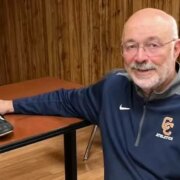
This spring the Clarke County High School sports community bids farewell to a mainstay of Eagles athletics for over two decades, wrestling coach Jon VanSice, who retired following the 2023–24 season. 

Before he built the wrestling program from the ground up into a state powerhouse, Coach VanSice mentored his two boys, Kyle and Zach, in their various sports which included baseball, basketball, soccer and, of course, wrestling. But he always had time for their friends too.

It wasn’t easy for my single mother to cater to her own twin boys and their diverse extracurricular activities. So, it was normal for Coach VanSice to swing by my house on the way to Parks and Rec and take a few of us kids to the baseball fields where, glove in one hand and bat in the other, he would pound balls at us until it got dark. There were endless evening sessions of soft-toss batting practice in his garage, soccer out front, and pickup basketball at the Rec Center. All of this in between shuttling us to practice after practice, all seasons of the year.

Thus, there was Coach VanSice manning the sidelines, at least as an assistant coach, for most of the important, memorable games of my youth: the undefeated rec soccer season; the 7th grade boys’ basketball championship win at the buzzer over Daniel Morgan; and the Clarke County varsity boys’ baseball team beating future MLB Hall-of-Famer Justin Verlander on his home field. It didn’t hurt to have Kyle as part of the former two, and Zach the latter. 

To those who know him and have seen his teams in action, it is no surprise that Coach VanSice was often on the sidelines to witness his athletes enjoy success. Tough, fair, demanding, understanding, patient, diligent, prepared and, above all, competitive — those are just some of the words that come to mind when I think of Coach VanSice. His athletes go hard, give it their all, and do not quit. And they do so respectfully and always with a spirit of true sportsmanship.

Recently, as I griped about the busy spring schedule of kids’ sports to a friend (because I don’t always have the patience of Coach VanSice; sorry, Jon!), they asked me: “Why do you coach?” The simple answer is that the coaches in my life, Jon VanSice chief among them, made a lifelong impression on me because of their selfless dedication to making our community better by developing its greatest resource — its youth.

So, it is suitable and satisfying (inevitable, even) that I often find my teams competing against teams coached by former athletes influenced by Coach VanSice. I know they echo the sentiment that carrying on his legacy of coaching youth sports for future generations is a tremendous honor.

As Coach VanSice and other inspirational institutional figures like him hand over the reins to the next generation, we, your former athletes, salute your service to our community. The least we can do is try our best to pass on what you have taught us about sports and about life.Congratulations, Coach Jon VanSice, on a well-deserved retirement. We all know you’ll still be on the sidelines.

Tickets On Sale For Main Street Chamber Orchestra

By Jon Goldberg

Join the Main Street Chamber Orchestra on Saturday, April 13 at 4pm, at Grace Episcopal Church, Berryville, for a performance of Beethoven’s groundbreaking Symphony #3, the Eroica. Long considered one of the two or three greatest works in the classical canon, the MSCO is excited to bring this work to our community. 

“Eroica” is an Italian word that means “heroic.” Although written over 200 hundred years ago, Beethoven’s narrative of a hero’s journey to self-realization has never lost its immediacy. The first movement is restless, driven, constantly in flux. Everything pushes forward, yet never arrives — much like a military battle, with great forces on the move, always in a process of becoming. Our hero, be it Napoleon or Beethoven himself, is constantly striving towards his own hard-won self-realization.

The second movement begins with a funeral march in the French tradition, something that had never been done before in a classical symphony. However, after a battle, you must bury the dead. Musically, what Beethoven buries are the strict formal traditions of the classical style. The movement ends with a moment of heart-filling grandeur that Beethoven never surpassed.

The third movement is Beethoven’s first true symphonic “Scherzo,” and is far removed from the courtly minuet and trio form of the typical classical symphony. It is exhilarating. As the funeral march followed the battle, the scherzo follows the burial and suffering, mirroring a return to life and joy.

In the fourth movement Beethoven again breaks formal tradition by using a theme and variation structure — a framework that many musical scholars believed could not handle the weight of an end-directed symphony. Borrowing the theme from his earlier Prometheus Variations, here the “ideal Hero” is transformed into a musical representation of an “ideal society” in a fulfillment of the Enlightenment Ideals Beethoven held so dear. 

Our concert on the 13th will open with the thrilling Clarinet Concerto #1 by Bernhard Crussell. Composed between 1808 and 1810, it is a delight from beginning to end — a virtuoso showpiece that is sure to thrill the listener. Born in Finland in 1775, Crussell is a contemporary of Beethoven’s and is considered to be the most outstanding Finnish composer before Jean Sibelius. 

Virtuoso clarinetist Garrick Zoeter is the Anna Lee Van Buren Professor of Clarinet at the Shenandoah Conservatory of Shenandoah University. He is also a founding member of the MSCO. Holding degrees from both the Julliard School of Music and Yale University, he is widely recorded and highly in demand as a freelance musician.

Tickets are on sale on the MSCO website: mainstreetchamberorchestra.org.Students under 18 are admitted free.

Clarke Monthly April 2024

Clarke Monthly March 2024

Shenandoah Valley natural area restoration efforts expand

Protection for rare sinkhole ponds, wetlands funded by natural resources 
damage settlement

More than 35 acres have recently been added to two Virginia natural area preserves in Augusta County as part of a long-term, multimillion-dollar effort to restore the South Fork Shenandoah River watershed contaminated by mercury 
decades ago.  

The Virginia Department of Conservation and Recreation, which manages the state’s natural area preserve system, acquired 26 acres of forest adjacent to the Lyndhurst Ponds Natural Area Preserve. The expansion, which brings the total acreage of the preserve to 376 acres, will make it easier for staff to manage the land with prescribed burns and invasive species control. 

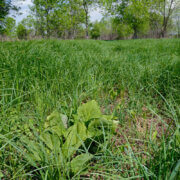
Lyndhurst Ponds, near the community of Lyndhurst, was dedicated in 2020 as a natural area preserve. It is home to globally rare Shenandoah Valley sinkhole ponds and rare plant and animal species. Among them are two rare plant species: the federally threatened Virginia sneezeweed (Helenium virginicum) and Valley Doll’s Eyes (Boltonia montana). 

“This new addition will better enable DCR’s natural area stewards to manage the rare species habitats at Lyndhurst Ponds Natural Area Preserve, which will include restoring portions of the the preserve to the native grasslands and open woodlands of the historic Shenandoah Valley,” said Jason Bulluck, director of the Virginia Natural Heritage Program. The former property owners, Waynesboro Nurseries and the Quillen family, were also critical to the establishment of the original natural area preserve. 

“Waynesboro Nurseries and the Quillen family are  delighted to contribute this additional acreage to the Lyndhurst Ponds Natural Area Preserve and protect more of this incredible natural habitat for future generations,” said Ed Quillen, president of Waynesboro Nurseries. “It was a wonderful opportunity to cooperate with DCR again and know that under their stewardship this legacy is in good hands.” 

In September, the agency acquired a 9-acre parcel along the South River adjacent to the Cowbane Wet Prairie Natural Area Preserve. That brings the total acreage of that preserve to just over 156 acres.  The parcel includes floodplain habitat along the south bank of the river in one of the most important remaining segments in the watershed, and conserves a critical buffer between the river and a residential area. It supports habitat for two rare plants and a globally rare wetland type called Shenandoah Valley Prairie Fen. On the western slope of the Blue Ridge in the Shenandoah Valley, Cowbane Wet Prairie protects outstanding examples of wet prairies, mesic prairies and calcareous spring marshes which were once common natural communities in the Shenandoah Valley. 

The funding source for the expansions at Lyndhurst Ponds and Cowbane Wet Prairie was the DuPont Natural Resource Damage Assessment and 
Restoration settlement. 

When DuPont produced rayon in the 1930s and ’40s, its facility in Waynesboro, Virginia, released wastewater containing mercury into the South River. The contamination impacted more than 100 miles of river, associated floodplains and habitats for fish, migratory songbirds and other wildlife. To settle claims stemming from that damage, the company paid $42 million in 2017 for restoration projects. The Commonwealth of Virginia and the U.S. Fish and Wildlife Service are trustees of the settlement funds.

An Unused Rail Corridor In the Shenandoah Valley Sparks a Fight Over What’s Next

Commonwealth Celebrates Keeping Conflict Out of Court

Law Matters

By Brenda Waugh

March is Mediation Month in Virginia, when the Commonwealth celebrates its strides in creating options for alternative dispute resolution, including mediation. In 1993, Virginia passed the dispute resolution proceeding statutes, legislation that has continued to play an essential role in institutionalizing the use of mediation in the courts.

Then, in 2002, the Virginia Administrative Dispute Resolution Act was signed into law, creating opportunities for numerous governmental entities to adopt mediation and other creative problem-solving methods to address disputes. The Act honors strides in the higher education community, recognizing the schools and universities incorporating mediation into their curriculum and the many private practice professionals who have developed a mediation practice. The proclamation recognizes that Virginia continues to be a leader in this field.

Among the state-funded and administered mediation programs are those in the courts and within some agencies. They include:

Family Mediation. Virginia’s program for court-initiated mediation in family law matters began during Governor Doug Wilder’s tenure from 1990 to 1994 when he championed initiatives to establish these programs. Today, in the Juvenile and Domestic Relations District Court (JDR), child custody and support cases are often referred to mediation after the parties initiate a suit to establish custody for divorce, or to establish child support. When the court refers the matter to mediation, selected from a court-approved list, mediators facilitate discussions at no additional cost to the 
parties involved.

General District Court. Mediation is also offered in the General District Court for cases involving debts, landlord/tenant disputes, and other matters. Parties attending court hearings may be invited to mediate on the same day, promoting efficient conflict resolution. The Supreme Court mediation programs pay costs. 

Appeals. Virginia extends mediation services to appellate cases. Disputants may appeal the matter when dissatisfied with a lower court decision. At that time, they have the option to participate in a state-funded mediation program with mediators who are attorneys with appellate experience.

Education. Parents dissatisfied with Individualized Education Programs (IEPs) or other unique educational plans can request mediation through their school board, with the school system covering the mediator’s costs.

Employment Mediation. EDR’s Workplace Mediation Program provides a free process in which neutral, impartial mediators assist Virginia state employees in exploring potential joint resolutions to their workplace conflicts. 

Fair Housing Complaints. The Virginia Department of Professional and Occupational Regulation (DPOR) provides mediation services for fair housing cases and specific regulatory complaints 
against licensees.

Workers Compensation. Virginia’s Worker’s Compensation Commission provides mediators to injured workers, deceased worker claimants, medical provider claimants, employers, insurers, claim administrators, and legal counsel to resolve disputes. 

Utility Digging. While not free, Virginia’s 811 service offers mediation for utility digging disputes, which helps to resolve conflicts in this 
area efficiently.

Virginia maintains community mediation centers throughout the state. with programs in Warrenton, Roanoke, Amherst, Charlottesville, Harrisonburg, and Fairfax. These centers provide workplace, community, and family mediation services. Virginia also supports a healthy network of mediators through their association, The Virginia Mediation Network.

Parties often decide to hire a private mediator, such as before litigation or complaints are filed, they may choose a mediator. Virginia has no licensing requirements for mediators (beyond those required by any business). However, the Virginia Supreme Court maintains a list of mediators who are qualified by their standards to accept mediations on their website at http://tinyurl.com/3ftyp43r.

Brenda Waugh is a lawyer/mediator with Waugh Law & Mediation, serving clients in the Blue Ridge region of Virginia and Eastern Panhandle of West Virginia.