The Mystery Of Roosting Wrens

Story and illustration by Doug Pifer

Just before I let the dogs out, I turned the porch light on and saw something that looked a lot like a pinecone resting on top of the corner post next to the porch ceiling. I recognized it because I’d seen the same thing there several years ago—a roosting Carolina wren.

Carolina wrens are abundant year round in the Shenandoah Valley. They’re familiar to rural folks for a tendency to build their mossy nests in unlikely nooks and crannies. At our place wrens have built nests and raised their young in a pocket of a barn jacket hung in a shed, under a plant in a hanging basket, and under the protective cover of a propane fuel tank. Unlike the migratory little house wren, a Carolina spends the winter here, often in the same territory it nests in.

How such small birds as wrens survive cold winter nights is miraculous. Even the hardiest of them must find a warm dry place to roost in the worst weather. Wrens and other cavity nesting birds often roost in their former nests or those of other birds. But sometimes they sleep out in plain view, like this one.

The first time I saw one roosting on top of the porch post, I had no idea what it was. It certainly didn’t look like a bird. Almost the size of my balled up fist, the object was round, dark, and covered with white specks like a ball of black string with tiny bits of white cotton scattered through it. Only when I walked up to investigate did it shrink down into a bird. I recognized the white eyebrow and rufous back of a Carolina wren in that instant before it flew off into the autumn night.

Many small birds fluff the feathers on their lower backs to cover their wings and bodies on cold winter nights. Presumably this helps them conserve energy and keeps their tiny bodies from losing vital heat, like sleeping under a down comforter. Chickadees, juncos, and other small species roost this way in trees among dead leaves or thick branches. A bird fluffed up to this extent, with its wings and its head completely hidden within the feathers, looks several times bigger than its natural size.

But unlike these other birds, a fluffed up Carolina wren shows luminous-looking white spots that are invisible when its feathers are in their natural daytime position. These spots make the roosting bird resemble a pinecone or some furry, spotted mammal.

Researching this subject, I came upon many photos and several blogs from other naturalists describing the mystery of the white spots on roosting Carolina wrens. A couple of them proposed theories as to why these wrens might behave and look this way, either for warmth or for camouflage. None had been able to reach a scientific conclusion.

For me, the thrilling thing about nature is just being able to see a plant or an animal being itself or doing something amazing. Knowing exactly why isn’t so important.

The Gift of Life Outside

By Doug Humphreys

There is an absolute satisfaction that comes with the sound of sizzling meat. At the sound of the sizzle, the tangy smell of raw flesh is immediately replaced by the earthy aroma of meat cooking in olive oil.

While the meat browns, there is a tok-tok-tok of a knife pecking a cutting board. Soon there are piles of onions, mushrooms, carrots, celery, and potatoes. At once they are scraped into the pot with the meat, another splash of olive oil to keep the sizzle.

When the meat is brown, a vegetable stock is added. Next are frozen peas and limas, some cilantro, a shot of gin, salt, and pepper. Then it cooks. All day it simmers. The flavor getting better with every minute that passes.

When you sit to dinner you realize that on the table before you is a gift. You are keenly aware that for you to consume the meal that will nourish you, other living things had to die. Vegetables were severed from the root and a deer fell to a bullet . . . your bullet.

You don’t feel bad or guilty; this is the natural order of things. But the point is not lost. Just because God made it this way doesn’t mean you can’t be thankful for it. Just because you can kill to eat doesn’t give you the right to take it for granted.

While you eat, you realize the gift extends beyond the meal itself. You remember time spent digging in the dirt—sowing, tending, and harvesting. You remember sitting in the woods, waiting quietly and patiently and watching the miracle of nature around you. The gift is not only a bowl of stew. The gift is a life spent outside.

‘Tis the season for gifts. There are few among us who aren’t thinking about them at the moment.

For those whose age is still in the single digits, the end game is the size of the pile. Those in their teens are concerned with gifts that are cool, like really cool. Twenty something’s want what they need, and that which will save their hard earned money. Those in their thirties are once again concerned with the size of the pile, but now for their own single digit family members.

The forties, for me, have been the most challenging age for gift giving because I’ve come to believe that gifts must mean something. Piles of plastic made in China and token gifts acquired because of a T.V. commercial now feel hollow and insincere. The problem is that finding a gift that is meaningful to the gifter and gifted is a tough accomplishment. It is far harder to find a thoughtful gift than it is to save for an expensive one.

If you are having trouble coming up with a gift this holiday season, try thinking like an outdoorsman.

Give the gift of sunrise. Granted, it’s not for everyone, but once you are out of bed and staring east there are few things as beautiful as dawn. This summer my family and I watched the sun come up over the Atlantic from the bow of a fishing boat. It was impossible to tell where earth ended and the heavens began, but the clouds were surely a red carpet to whatever comes next.

For friends who are burdened by the daily grind and rarely escape the bonds of the concrete jungle, give them the gift of a sit in the woods. It’s hard to understand how tightly we are wound until we truly give ourselves a chance to unwind. There is no better way to decompress than sitting beneath the canopy of a hardwood forest. If the view won’t relax you, the smell surely will. Not to worry if few words are spoken, you’ll be surprised at the connection you can have with another person when you sit still and say nothing.

For family you haven’t seen in a while, give them the gift of a meal. Tell them about the potatoes you dug, the beans you picked, and the deer you hunted. Don’t give them your secret recipe, show them. Share the sizzle of meat and take turns chopping veggies. While the stew simmers, ask them how they are doing and then listen to their answer.

Just before you serve the meal take a moment to give thanks for all the gifts that surround you, whatever they may be.

Dreaming Up a Contemporary House

By Wendy Gooditis

Have you ever thought about what your perfect house would be? Have you designed a house in your head? “Let’s see, I have to have beautiful, natural materials. It has to be spacious, yet cozy. Simple, yet beautiful. Convenient, yet comforting.” And so on.

Jay and Peggy Duvall of White Post have done just that. In fact, they dreamed so long and hard (for a decade) that they magicked their ideal house into existence! I have stood on their porches, walked through the rooms, gazed at the timber framing, so I can attest to the reality of this house risen from a dream.

Really, it is no surprise that this timber and stone, glass and concrete structure has been brought to being out of the marriage of these two minds, one belonging to an architect and gifted artist, the other belonging to a designer and gifted manager. Together they run the Duvall Designs Gallery in Millwood, where Jay’s artisanal furniture, gorgeously rendered from local woods, is mingled with the work of visiting artists invited by Peggy.

Back at the house, I listen to Jay describe the fashioning and joining of the soaring timbers that form the frame of the house (“Tenons, pegs, green oak which is brought into tension as it dries . . .”). I hear Peggy’s laughter as she tells how many strong men (six!) it took to wrestle the immense slab of granite onto the island. I admire the stone fireplace as the Duvalls describe the various heating options—wood furnace in a shed that heats three buildings, another traditional heat source for when no one feels like feeding the wood furnace, radiant concrete floors downstairs. In short, the best of old and new, in a passive solar house with solar panels on the roof which contribute 30 percent of their electricity needs. “Everything about this house is efficient,” Jay says. Peggy adds, “There’s nothing I would change. I don’t think there’s anything lacking!”

In the foyer I gaze at the wall of stained glass, reminiscent of Frank Lloyd Wright in design, but updated and in entrancing jewel tones. “I must have the artist’s name,” I tell the Duvalls. They grin and Jay looks modest. “You’re kidding!” I exclaim. They’re not kidding. Jay not only designed the glass wall, but made it too. He not only dreamed up the sleek walnut cabinets, he fashioned them (along with friend Ammon Kerns, a wizard with cabinetry). It was his hands (along with others’) as well as his design which married the timbers.

The designer in the family takes me up to the spacious second floor sitting room. “We had stayed in a beach house with an upstairs family room, where all the kids could hang out,” says Peggy. And their grown kids and grandchildren did just that over Thanksgiving week, spreading out happily into two upstairs bedroom suites and the family room, while the Duvalls stayed cozy in their first floor master suite.

The house is sited privately on 60 acres carved from Greenway Court where Lord Fairfax had his hunting lodge, “his party barn!” says Jay. Peggy adds “George Washington’s office is still over there. It’s a neat part of history.” Two of the ancient roadbeds from that era still wend their way across the property.

The site was completely overgrown when they first laid eyes on it, and no one was more surprised than they to find they had purchased 60 acres when they had set out to buy one! But with its hills, woods, fields, pond, and old stone walls, plus an atmospherically decaying cabin in the woods, the property had the magic worthy of their dream. The deep, heavenly porches make me long for a hot mug and a quilt so I can be snug in a chair and enjoy the pastoral prospect.

Surveying the house from the outside, I am struck by the unusual harmony of various elements: the old-fashioned tapering stone chimney with clay chimney pots. The timber-framed window in the stone wall, forming a pleasing contrast to the sleeker stained glass of the nearby entry-way. I remark to Peggy that its appearance is almost as antique as it is modern! “Yes, for all the contemporary aspects of this house, it has an old-world feel,” she replies.

I turn to see the sturdy, Craftsman-like 2-car garage with apartment above and attached exercise room and garden room (more stained glass!). Beyond is the huge workshop with a kitchen plus two lovely upstairs offices and bathroom. Nearby is the large greenhouse: “A working greenhouse, not a toy greenhouse!” Peggy points out. Then there’s the big barn, with room for ten stalls plus feed and tack rooms. There are pastures too, including a board-fenced paddock with a run-in shed.

Sadly, the Duvalls are working up the courage to leave this, their idea of heaven, and the property is on the market. Much as they love it, they have other endeavors they wish to pursue, and feel that simplifying their home life would help. But it is certainly hard. “We put our heart and soul into this house,” says Jay. “But this house will outlive us all and it will serve people for generations without a whole lot of grief,” Peggy adds firmly. And I believe it will.

Wendy Gooditus is a realtor with ReMax Roots in Berryville.

Shenandoah University Named Official Site for Shenandoah Valley Writing Project 

National Writing Project (NWP) recently selected Shenandoah University as the official site for the Shenandoah Valley Writing Project (SVWP). The SVWP joins a network of nearly 190 local sites of the National Writing Project, serving all 50 states, Washington, D.C., Puerto Rico and the U.S. Virgin Islands.

The mission of the SVWP is to improve both writing instruction and the use of writing as a tool to enhance learning in all content areas, from kindergarten to the university setting. The group strives to elevate teachers to teacher-leaders and to raise the professional stature of classroom teachers. It also serves to support and enhance the literacy of the surrounding area through programs for both young writers and adults, in addition to its work with practicing educators.

The SVWP focuses on three core beliefs: 1) all students can and should view themselves as writers; 2) writing is the most effective tool for learning in all content areas; and 3) classroom teachers are the most effective teachers of others in their profession.

The program is led by John Handley High School’s Porterfield Endowed English Chairperson Mary Tedrow, NBCT, M.Ed., who serves as director, and Shenandoah University’s Director of Teacher Licensure and Professor of Curriculum and Instruction Mary Bowser, Ed.D., who serves as principal investigator and site director.

“This site gives the teachers of the Shenandoah Valley a home,” said Tedrow. “The university community and physical space allow teachers within our network to continue to learn and grow together. We have space, the support of credit-bearing courses for the work, and the intellectual fervor of the university community to engage and energize the teaching network. We are grateful that Shenandoah University has welcomed us.”

Tedrow cited Shenandoah’s annual Children’s Literature Conference (which will celebrate 30 years in 2015) and its Claude Moore Center for Literacy (CMCL) as programs that augment and amplify the work of the SVWP. “We think the synergy of these three programs will be a boon to the area going forward,” said Tedrow.

Since 2005, the SVWP has operated as a satellite of the Northern Virginia Writing Project (NVWP) at George Mason University. As the group has increased in size and scope throughout the years, it is now its own entity, able to serve not only Virginia writers but individuals in West Virginia, Maryland and other areas not served by NWP sites.

Independent site status allows the SVWP to build its own independent infrastructure and form local alliances with the school districts it serves, which will strengthen the efforts of the network. However, the group intends to sustain an ongoing alliance with the teacher consultants of the NVWP.

“We are thrilled that Shenandoah University is now home to this fundamental and essential program,” said Bowser. “Not only does it enrich our course offerings, but it is also an honor to provide a way for local educators to continue their professional development and training and, in turn, impact the writing of their students.”

Each summer, the SVWP holds a four-week, Invitational Summer Institute for exemplary teachers from throughout the area. Those who attend this writing institute span all content areas, and through the learning process, they become teacher consultants. They are then expected to take their training and techniques back to their home school systems to train fellow educators in the process.

“Every time a school system sends a teacher to this workshop, their teacher receives the latest and greatest ideas for the consultants to take back to their school for staff development,” said Bowser.

The 2015 Invitational Summer Institute will be held at Shenandoah University from Monday, June 29, through Friday, July 24.

Shenandoah University is now the seventh NWP site in Virginia; other host universities include George Mason University, Old Dominion University, the University of Virginia, the University of Virginia’s College at Wise, Virginia Tech and the College of William & Mary.

“We have been on a long journey and are gratified and excited that Shenandoah University has agreed to partner with the teacher consultant community of the Shenandoah Valley,” said Tedrow. “We know that our partnership with the other literacy initiatives will make the schools of the Shenandoah Valley able to provide an even stronger experience for our students.”

Shenandoah Seasonal Makes Farming a Year Round Venture

by Annie Young

From James Madison University to a Clarke County farm by way of Cambodia may seem like a circuitous route to many, but that’s exactly how Daniel and Ali Haney found their way home. The couple met at college, and after graduating Ali took an opportunity to work at a small learning center for needy children in Cambodia. After a stint in the states, she returned to Cambodia—this time with Daniel coming along working as an administrator. As they planned their return to the U.S., they talked about finding work that was as rewarding as their community service in Asia.

One of the things they loved most about Cambodia was the outdoor market, where people shopped in the morning and evening every day looking for the best and freshest food. This inspired Ali and Dan to look to agriculture as they transitioned back to the United States. They wondered how could they promote fresh and seasonal food in their lives and community.

After returning to Virginia, Daniel, who grew up in Clarke County, worked as an intern at Smith Meadows farm, learning about sustainable livestock. Then he and Ali started Shenandoah Seasonal farm using some of his parents’ land in Millwood. They began growing vegetables and raising pastured chickens for eggs. The couple married, and Ali started farming full time last spring.

They serve farmers markets in Leesburg and Ashburn, and host a CSA subscription program that operates from June to October.

This time of year is typically not a productive one in the fields for most farmers. But it does not take long to see the difference at Shenandoah Seasonal. Lengths of wire with the ends stuck in the soil form a rainbow shaped tunnel low to the ground. Lifting the edge of the protective cover cloth, rows and rows of green brightly greet you. Arugula, mustard greens, and spinach are all growing–proving that Shenandoah Seasonal is, indeed, a four season farm.

Shenandoah Seasonal uses sustainable and organic growing methods. Using raised beds and covered high tunnels to protect the produce, they can ward off many pests without ever using chemicals. They also use cover crops to add nutrients to the soil instead of synthetic sprays. These intensive methods are a lot of work for the farmer. Valuing quality and sustainable practices even starts with the seeds they use. They use only USDA certified organic seeds from companies that offer heirloom and specialty varieties.

The chickens are raised in pasture, and supplemented with non-genetically modified feed and non- chemical feed. The chickens have plenty of room to graze as they peck through the soil to find bugs and other things they find delectable.

As Shenandoah Seasonal weathers another winter growing for market, they are also preparing for their spring CSA season. Members buy a share before the season starts, then each week pick up their produce from the farm at their new convenient location in Waterloo. The CSA offers a dozen eggs for each customer in addition to the seasonal produce. Vegetables include lettuce, spinach, beets, Swiss chard and herbs in the spring. Summer brings infinite variety, with eggplant, peppers, beans, onions and, of course, tomatoes. Autumn’s seasonal vegetables are lettuce varieties, kale, spinach and onions. The season for the CSA ends in October, but customers can find their produce throughout the winter at the Leesburg Farmers Market.

Check out Shenandoah Seasonal at www.shenandoahseasonal.com or 540-535-5474.

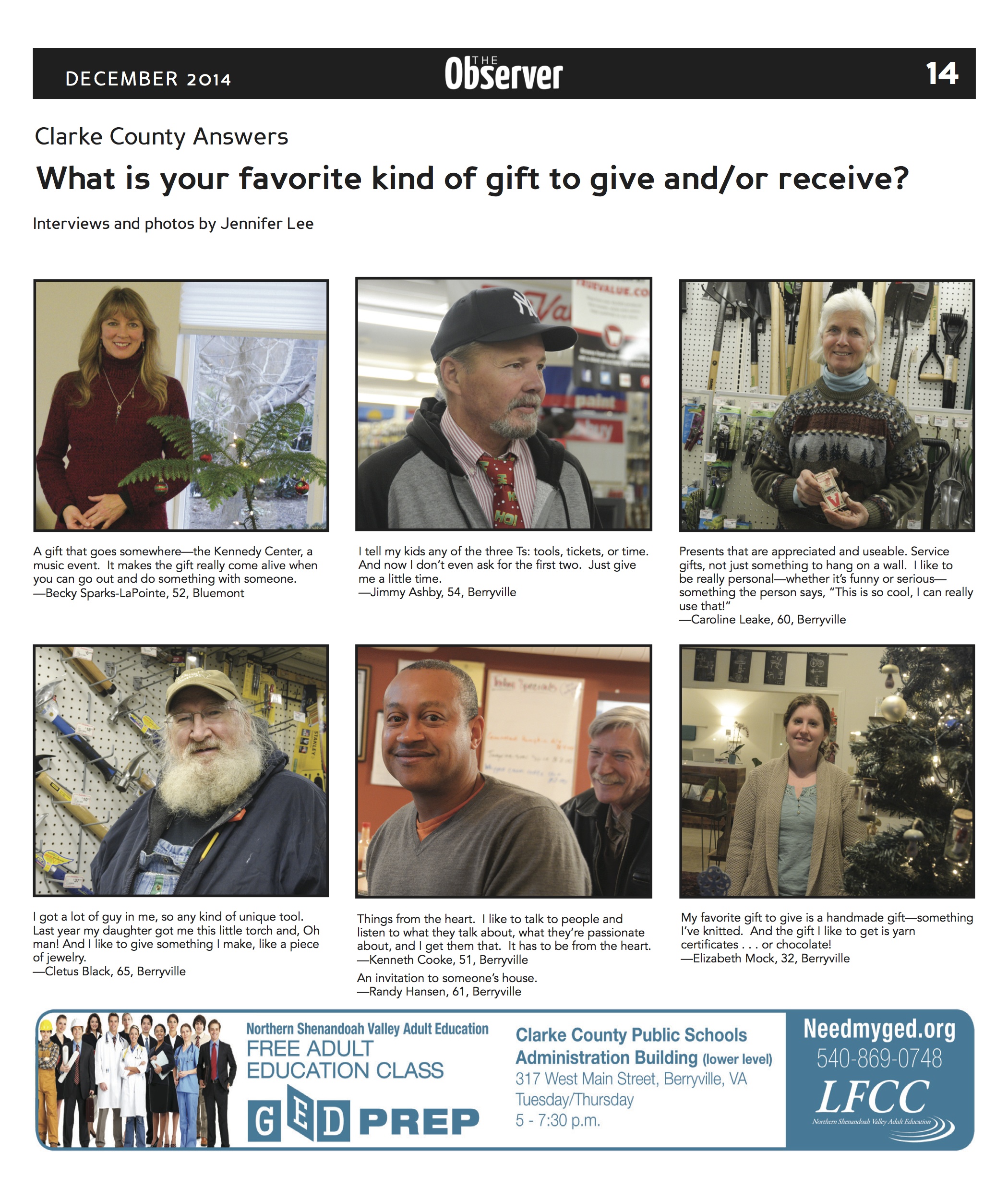
What is your favorite kind of gift to give and/or receive?

Bland Competition Offers Local Talent Chance To Shine

By Victoria Kidd

We often talk about the talent of professional musicians and entertainers who perform at venues in the area, but we should also recognize that Clarke County has its own share of talent. Our community fosters that talent in a number of ways. One such way is the upcoming James A. Bland Competition at the Barns of Rose Hill. The competition is a music scholarship event and performance opportunity for area youth. This year’s event is scheduled for February 11th at 6pm.

The effort is part of a larger Lions Club International program that benefits and assists youth by providing performance opportunities and scholarships to gifted vocal and instrumental music students. Lions Clubs International is one of the largest service organizations in the world. These clubs (with their 1.3 million members worldwide) serve communities in need by providing vision and health screenings, building parks, supporting eye hospitals, awarding scholarships, assisting youth, and providing help during natural disasters. This scholarship program is but one of many worthwhile endeavors the organization champions.

It’s a program with a rich and interesting history of its own. It’s named for James Bland, an admired African-American minstrel whose work was popular in the late 1800s. Bland was a prolific writer and is credited with creating more than 700 pieces. (One of Bland’s compositions once served as the state song of Virginia and is currently the “state song emeritus.”) Bland was a self-taught musician who attended Howard University. He became a regularly requested performer by the time he had reached his mid-teens. By most accounts, he was a “natural” musician with a consuming passion for music starting at a very early age. It is fitting that a competitive event showcasing the talent of young performers bears his name.

The scholarship program was established in 1948. Competitors must perform pieces that they have committed to memory and that are no longer than 8 minutes. The upcoming event at the Barns of Rose Hill is what the Lions call the “club-level” competition. The first place vocalist and the first place instrumentalist will be invited to compete in the “zone-level” competition where winners of that competitive level will move on to the “district level.” There are six district level competitions within the state, and these events will designate six competitors who will battle it out at the state-level competition.

Performers who make it to the state-level event will be competing for prizes ranging from $1,000 to $2,500, but participation is about more than simply the pursuit of scholarship funds. Local Lion Sharon Hart explains that the simple act of participating, even if it is only at the club level, is beneficial for these young musicians. “It’s a long progression from the club level up,” she says. “These entertainers have a chance to polish their presence while performing in front of their parents, peers, and community.”

As they progress through the competition, they are gaining experience performing, and that can only benefit those wishing to continue on to a career in music. Those talented enough to be asked to compete at the state level will find themselves in good company. “At the state level,” Hart says, “the performers are simply phenomenal. The talent these young people have is really impressive. Those who compete at the state level almost always go on to careers in music.”

According to the official website of the James A. Bland Music Scholarship Program, finalists who have competed in the competition are enrolled in prestigious schools such as the Peabody Conservatory of Music of the Johns Hopkins University, Cornell University, Carnegie Mellon’s Musical Theater Program, The Julliard School, Yale University, and others. Seeing the success of these talented young musicians has left Hart and her husband Greg (also a Lion) feeling very proud and privileged to be able to support the endeavor.

The Harts have been involved with the scholarship program for years, and they have seen their share of talent over that period. They are joined by between thirty and thirty-five other Lions Club members who will volunteer or participate to some degree in the upcoming program. Hart says that the club feels fortunate to have the opportunity to partner with the Barns of Rose Hill to showcase the talent of the county’s youth within a setting that is truly beautiful.

“The Barns is the perfect venue for this event,” she says, “and they have been the perfect partners. It’s a beautiful space, it’s a community space, and we truly think that it is fitting for what we are doing. The community as a whole is saying we are invested in the talent and the future of these young people—these musicians who are living right here among us locally. It’s really great to be a part of this, and we think those who want to see something really special happen should plan on attending. We think it is also special that this program and the support of the Barns gives these young people a chance to perform at a place where so many talented performers have also entertained audiences. It’s a great place to start for them.”

The opportunity to start one’s performance history at the Barns is open to Clarke County students and home schooled students alike. Registration information is available at http://www.e-clubhouse.org/sites/clarkecountylionsclubva/page-10.php. Hart also invites individuals with questions to call 540-955-6229.

If you know a school-aged vocalist or musician whose talent needs to be shared with the community, invite them to visit the club’s page or call Hart for more information about what she calls a “uniquely Virginia scholarship program.” In doing so, you may have just provided them with the first step towards a lifelong career sharing their music—and representing the talent of Clarke County—with the world.


An Invitation to Hear Talent from The World Over

By Victoria Kidd

Music is among the greatest of all humankind’s innovations. It is valued and understood universally, and musicians are the custodians of this tremendous creation. Musicians commit to a life of practice and continual development. They surround themselves with those of like mind—those who share their love of music. An upcoming symposium that is being held locally is such a gathering, and it affords a unique opportunity for locals to enjoy an evening of exquisite compositions.

The 37th International Saxophone Symposium, hosted by the United States Navy Band, is being held January 9 and 10 at Shenandoah University with additional symposium events taking place at the Patsy Cline Theater at John Handley High School in Winchester. The two-day event was first held in 1978 following an official order from a Navy officer. Today, the event features a mix of performances, master classes, and lectures that appeal to musicians and music lovers of all ages and experience levels.

This year’s event marks a jubilant return of the symposium after it had to be cancelled last year because of budgetary cuts resulting from sequestration. Perhaps best described as a “comeback event,” the 2015 symposium certainly boasts an impressive lineup of talent that will be featured during its marquee concerts on Friday and Saturday nights.

Traditionally, Friday’s concert features the U.S. Navy Concert Band as it entertains the audience with a “mixture of band pieces and classically oriented saxophone solos,” according to the symposium’s website. The Concert Band is the original ensemble of the Navy Band, and it is their premier wind ensemble. For over 85 years, the Concert Band has performed at public events and high-profile occasions. It is considered to be one of the finest wind ensembles in the world.

Saturday night offers a chance to enjoy an evening of big band and jazz music performed by the U.S. Navy Band’s jazz ensemble, The Commodores, who will be performing alongside a variety of acclaimed guest soloists. As the Navy’s premier jazz ensemble, the Commodores have been performing and entertaining for more than 40 years. Today, the 18-member group is led by Master Chief Musician Philip Burlin. The group participates in public concerts, national concert tours, ceremonial events honoring veterans, and protocol performances for various officials.

Several widely celebrated guest soloists will join these musicians over the two days. Among them is Vincent David of Bagnolet, France. David, one of the foremost classical saxophonists in the world, is a renowned proponent of “new music.” His experience includes collaborations with noteworthy composers including Luciano Berio, Pierre Boulez, Bruno Mantovani, and many others.

David is joined by James Houlik, the world’s leading performer on the tenor saxophone, and Canadian saxophonist Michael Ibrahim, an internationally recognized soloist, collaborator, and clinician. Houlik is known as a pioneer and advocate for the tenor saxophone, and his efforts have resulted in the composition of more than eighty-five new concert works for the previously overlooked instrument. Ibrahim is, in contrast, the winner of numerous competitions including the North American Saxophone Alliance Classical Artist Competition, the Eisenberg-Fried Concerto Competition for Woodwinds, the Coleman Chamber Music Competition, the MTNA Woodwind Collegiate Artist and Chamber Music Competitions, and a Darmstadt Performance Prize for Contemporary Music.

In addition to the performances of these talented musicians, guests will certainly enjoy the Navy Band Saxophone Quartet that features Jonathan Yanik, Patrick Martin, David Babich, and Dana Booher. The group plays music in a variety of styles, ranging from standard concert saxophone quartet literature to contemporary and jazz pieces. These musicians are experts at tailoring their selections to suit a wide range of audiences. They perform regularly at recitals and concerts throughout the year, and they frequently visit schools as part of the band’s Music in the Schools education outreach program.

Another quartet that will assuredly entertain is the Miami Saxophone Quartet, native to South Florida. Musicians Gary Keller, Gary Lindsay, Ed Calie, and Mike Brignola explore the realms of Jazz, Pop, Latin, R&B, and chamber music while performing original songs and their own arrangements. Guests can expect to enjoy pieces from the likes of John Coltrane, Paul Simon, Pat Metheny, James Taylor, Thad Jones, and Chucho Valdez. The diversity of these pieces reflects the flexibility and wide-ranging appeal of the saxophone.

Overall, these performances are only part of an ambitious two-day undertaking including 114 individual events. The program has been created through a unique partnership between the Navy Band and our local university. Musician 1st Class Joshua Arvizu, a master of the oboe and the English horn, explains, “The idea to combine the resources of Shenandoah Conservatory with the vision of the Navy Band’s International Saxophone Symposium was a natural one. Both organizations share the same desire—to display the sights and sounds of a relatively unknown and misunderstood instrument for both international saxophone professionals and a community with a rich history and love for good music.”

He continues, “After 35 years in Washington DC, the International Saxophone Symposium had built a reputation as the single largest-attended saxophone event in the world and they were looking for a new home. Shenandoah Conservatory is also building a reputation as one of the fastest growing saxophone programs in the world. It was too good of a match for either organization to turn down.”

While bringing well-known performers to the region, the event also includes an opportunity to see up-and-coming talent through the inclusion of the college quartet series. “Since 2003, the symposium has offered a national-level performance opportunity for college saxophonists,” Arvizu says. “This year we have 27 college quartets!”

With all of these performers coming from the world over, the event is undeniably one of interest to locals from across the Valley. For musicians and music lovers, the 37th International Saxophone Symposium is an event that must be attended. Arvizu and his fellow musicians invite you to share this occasion with them. “After all, what good is great music without an audience?” he asks. Visit the official symposium site at http://www.navyband.navy.mil/Saxophone_Symposium.shtml. There you will find artist biographies and a schedule of events to plan your attendance. The symposium is free but tickets are required for the two evening concerts. To order your free tickets go to usnavyband.ticketleap.com.

Orrin and Ted and Hope for the New Year

Thinking about the coming new year, which, like every year, is born amid a blending of hopefulness and concern for what lies ahead, I find myself listening once again to a favorite radio interview. Now more than five years old, it’s an interview with Utah Senator Orrin Hatch that appeared on National Public Radio on the death of Massachusetts Senator Ted Kennedy.

Unless you’re a dedicated Congress watcher, you may not know that the two U.S. Senate icons from opposite sides of the aisle were also dear friends. That’s right. In the anger machine that has become U.S. politics in recent years, you might find it impossible to imagine a time when heavyweights like The Liberal Lion and the Mormon conservative could be, at once, their respective party’s champions for diametrically opposing views of government and close friends.

Legend has it that the Utah Senator had come to Washington three decades earlier with one goal: to fight Ted Kennedy. And fight they did, as Hatch recalled: “tooth and tongue, but afterwards we’d put our arms around each other and laugh about it.” Sen. Hatch goes on to say, “We passed a lot of very important legislation together, and I will greatly miss him.”

Already, I can see eyes rolling and hear the harrumphs of readers on the left and right bemoaning that the problem with that generation of politicians was that they were too willing to compromise. Another way to look at it is this: When people treat one another with respect and try to understand one another’s perspectives, they stop trying to steamroll each other and they start working on solutions. Maybe even become friends.

Today, a spirit of shared purpose has trouble competing with “winner-take-all gotcha.” We’d rather be angry and get nothing done.

Maybe it’s just the times we inhabit. I remember the conversations of my elders, and how sometimes minds were changed—or at least expanded—from time to time through genuine dialogue. Even my father, a dyed-in-the-wool liberal Catholic union guy, might nod his head and say, “I see what you’re saying,” when someone said something that if I’d said it I would have gone to bed without supper.

That’s why I like listening to Sen. Hatch’s interview each year in the waning days of December. It reminds me that we don’t have to compromise our principles just to find compromise to a challenge.

It’s why every year my New Year’s Resolution is to be a better listener; the Hatch interview cheers me on. I always fail, usually miserably, before January has passed, but I haven’t yet given up hope!

Whatever your resolutions for 2015, wishing you success, prosperity, joyfulness, and friendships with people who are different from you.

—From all of us at The Observer of Clarke County.

If you’d like to listen to Sen. Hatch’s interview, visit http://tinyurl.com/m2o6to or search at npr.org.