How deep is your generosity?

By Karen Cifala

It is said that the Baby Boomers are the most generous generation. Really? I didn’t know that. It’s been reported that they are responsible for 43 percent of the giving in the USA because they are now in their peak earning years. Forty-three percent—wow! Despite not being very well prepared for retirement, they apparently feel they have more cash to give, or maybe they have other things to give as well.

In a recent article in the Guide to Retirement Living (www.retirement-living.com, which by the way is a great book to pick up because it’s free and has an abundance of helpful information), I learned about a national study done in August 2013. It explored modern family interdependencies and the challenges Boomers faced in balancing them with their own retirement planning and financial security.

The study was conducted with a survey of more than 5,400 respondents over 50 years old, and it uncovered the fact that three out of five Boomers have provided financial assistance to members of their families, including their parents, children, grandchildren, siblings, or other relatives. This assistance was offered with no expectation of return, with the average financial assistance provided being $15,000 during the last five years—much more than that in the wealthiest families.

Also pointed out in the article was the fact that no matter what your long range financial plan was, most likely it didn’t include support for family members (according to 88 percent of respondents). Hint: bring that up with your financial advisor next time you meet! Time to build it into your retirement plans?!

Many of the other highlights of the study I found very enlightening included topics that I hadn’t necessarily considered “giving,” until I stopped to think about all the ways that one gives. Not just in a monetary sense, but in ways which still impact financial preparedness.

The Family Bank. There seems to be one member of every family who is the most financially responsible and approachable.

Sacrificing retirement for family. Sixty percent said they would retire late, 40 percent would return to work, and 36 percent say they would accept a less comfortable retirement lifestyle to help family members out. That’s generous, all right!

“Because it’s the right thing to do.” People age 50 and over are 20 times more likely to say this because their mindset, especially regarding inheritance, is to begin passing it along during retirement, rather than waiting until end of life.

Blended families and their effect on finances and planning. Nearly 2 in 5 people over age 50 are part of a blended family, and nearly 1/3 of those admit that it complicates financial planning, but still say they wouldn’t change a thing!

Perpetual parenthood and boomerangs. 1 in 5 parents have had at least one boomerang adult child who has moved back in with them and more than 2/3 of parents have provided some form of financial support. That’s got to have an effect on retirement plans!

Care-giving and receiving. No surprise here: 91 percent say they are not prepared to take care of their parents or a relative if long-term care is needed, and most people prefer to receive care in their own homes. Many Boomers are giving up their jobs and moving back in with their parents to take care of them. Generous, for sure!


Not surprising to me is that half of adults over age 50 have not discussed any important topics such as a will, health directives, inheritance plans, and where they plan to live in retirement with their adult children, much less how they should be financially cared for. This study pointed out a very important fact: proactive discussions and coordination with family members can be the difference between smooth sailing and significant hardship when confronting financial challenges leading up to and through retirement.

Across all relationships, fear of conflict ranked as a top barrier to discussion, while death or illness were the most common catalysts to finally broach difficult topics. It occurs to me that if we want to leave a legacy as “giving” people, maybe we should add another point of giving: If you are really feeling generous, give good advice and good information to your parents AND to your children. It’s FREE!

The valuable resources below are a good place to start:

Shenandoah Area Agency on Aging in Front Royal; www.shenandoahaaa.com (540)635-7141

VICAP; local help with your Medicare questions: (540)635-7141

Virginia Easy Access; www.easyaccess.virginia.gov

National Association of Area Agencies on Aging; www.n4a.org

Senior Navigator — www.seniornavigator.com

US Social Security Administration; www.ssa.gov

US Veterans Affairs Department; www.va.gov

Karen Cifala, a realtor for Remax Roots in Berryville, is a senior real estate specialist specializing in transitioning and time-of-life issues facing seniors and their families. She is a member of the Professionals Working 4Seniors Resource group and has a wealth of information to share. She can be reached at (303)817-9374 or at Remax Roots in Berryville at (540)955-0911.

Celebrating Two Years in the Community

This month we celebrate the 24th edition of The Observer of Clarke County.

We are still a work in progress, and expect that will always be the case. We’ll always try to improve and keep things fresh while honoring the history and special character of the community.

But one thing that will never change is our core vision of what we are trying to create and maintain as your community paper. While it’s partly about telling the stories of the community, of getting a snapshot of a moment in time, for us it’s also about inviting the community to participate in telling those stories.

Whether it’s news about charity events or art openings, a sensitive issue about school funding or disagreement over regulation—like a story covered in this edition—the community is both the story and the storytellers.

We hear folks say that they feel like the Observer belongs to them. And that’s the way we feel, too. That is our goal.

Already, a lot of people pitch in. In this edition, for example, there is a photo by Michael Hobert in the story about water regulation. He had emailed about something else while I was frantically looking for a photo, so I shot back, “Hey, can I use one of your farm photos? I’m doing a story about Waters of the U.S.” A short while later there were several choices in my email box.

That’s how some of Pam Lettie’s wonderful pictures have also appeared in the Observer; she pitched in to help illustrate a community story.

That’s the way a lot of the stories come to us, too—from a telephone call or an email pointing out a story that the community might want to know about.

Sometimes it’s like being the telephone operator on the Andy Griffith show, like when someone called a few weeks ago to inquire about the whereabouts of our writer Jennifer Lee—“haven’t seen her lately.” I assured the caller Jennifer was okay; she is working on the American Conservation Film Festival over in Shepherdstown (which, by the way takes place the last weekend of the month).

Ultimately, we couldn’t tell community stories without the support of our advertisers. They are partners in this community venture. Without them we couldn’t do it. When your Observer arrives each month, we hope that you take the time to notice each advertisement and support the businesses that help keep us coming. Especially as the holidays approach, look to shop locally.

You can support the Observer by supporting our advertisers. While you are there, thank them for bringing you your community paper.

Thanks to everyone for your support and your participation!

Brother James Sommers’ Collection To Be On Display

The Battle of Cool Spring raged on along the banks of the Shenandoah River July 18–19, 1864. This July 19, 150 years later, as part of the sesquicentennial for the event, visitors can see a collection of artifacts found at the site over many years. The exhibit, Relics of Cool Spring at Shenandoah University’s Shenandoah River Campus at Cool Spring Battlefield, presents the finds of Brother James Sommers, including bullets, rocks, and personal artifacts.

The exhibit begins its run Saturday July 19th 11am–4pm and will be available afterward by appointment throughout the summer ending on September 30, 2014. Appointments may be made by calling the Clarke County Historical Association. This exhibit gives the viewer an appreciation for the time and effort Brother James Sommers put forth putting the collection together. Before the preview a special tour of the battlefield with National Park Ranger Shannon Moeck and Lord Fairfax Community College Professor Jonathan Noyales will lead the July 9 tour beginning at the gift shop of Our Lady of the Holy Cross Abbey, 901 Cool Spring Lane, Berryville. The tour is part of the “On this Day” Anniversary Tour to commemorate the 1864 Shenandoah Valley Campaign.

Brother James Sommers came to Holy Cross Abbey in the late 1960s and lived there until his death in 2011. He served in many roles at the abbey; from mixing the dough of their popular bread, acting as head librarian and greeting visitors to the gift shop at the Abbey. It was during this last role that Brother James Sommers discovered that the details surrounding the Battle of Cool Spring remained a mystery. Most information, including the exact location and name of the battle were largely forgotten.

As a history buff, Brother James Sommers was glad to do the research to find out the details surrounding the battle. He used a metal detector put together by several monks to find some of the artifacts. With the approval of his Abbot, he soon unearthed hundreds of objects including bullets, buttons, and buckles. Those artifacts along with soldier’s diaries, letters, and official records told the story of the Battle of Cool Spring.

“As a parent I can’t wait to take my daughters on the tour of the Cool Spring property,” Local author and historian Stacey Graham said. “ Opportunities like this one do not come along often.”

Throughout his life Brother James Sommers contributed a great deal to the understanding of the Battle of Cool Spring. For more information email outreach@clarkehistory.org or call 540.955.2600 with questions or comments.

Modern Sporting Rifle A Bold Step Forward

By Doug Humphreys

I was once told by a D.C. lobbyist that nothing stays the same. Everything (especially those things political in nature) grows or shrinks, flourishes or flounders, succeeds or fails—but there is no such thing as status quo. You either stay relevant through positive change or you simply fade away.

Historically the firearms industry is a political poster child for growth and self preservation by constant forward movement.

In 1860 Christopher Spencer finished the design of the Spencer rifle. This rifle revolutionized the shooting world by ending the need for stuffing explosives down a barrel through the use of metallic cartridges while also allowing for seven consecutive shots thanks to a tubular magazine and simple lever for reloading. Though loading was faster and easier, the lever mechanism did not cock the hammer.

In the late 1860s and 1870s John Marlin and Oliver Winchester introduced several models of lever action rifles that held more and more powerful ammunition. The lever was faster and more durable, and cocked the hammer during reloading. Lever action rifles would claim their fame in the American west. The Winchester Model 1873 was dubbed “The Gun that Won the West.”

In 1891 Sergei Mosin and Leon Nagant introduced the Mosin-Nagant. Soon after in 1895 Paul Mauser patented the Mauser 98. Though not as quickly reloaded as the lever action, the bolt rifle reached new levels of accuracy with a more simple and more durable design. A stacked magazine also allowed for pointed bullets which revolutionized ballistics and led to an explosion of new cartridges.

The bolt action would become by far the most popular rifle among sportsmen. In the post WWI United States, Garands were adapted for sport, marking the birth of the bolt gun and the 30/06 in the big game hunting fields—the most famous being the sport-adapted Garand carried by Teddy Roosevelt on expeditions around the world. Today the makes and models of bolt rifles and the variety of ammunition to load in them are almost limitless.

The Modern Sporting Rifle (MSR) is the latest bold step forward by the firearms manufacturers. The rifles have a very simple design that favors practicality over aesthetics. The rifles are modular, which not only ensures simplicity but allows a part from company A to be put on a rifle from company B. This creates convenience for the shooter and keeps prices very low on parts and complete rifles.

The rifles can be adjusted to shorten the length of pull, meaning that dad can lengthen the stock for a morning hunt, then shorten the stock with the flip of a lever and give the rifle to mom or son or daughter for their evening afield. The Picatanny rails allow open sights, dots or scopes—ensuring anyone can hit what they are aiming at with whatever aiming device they prefer.

A shooter or hunter can also change the caliber of an MSR simply by changing the upper half of the rifle. This means that the more uppers a shooter has, the more savings he achieves on his investment. And the common sense design of the MSR has the sighting mechanism connected to the upper, which means calibers can be switched without the need to re-sight the rifle.

The modular designs cause the rifles to rattle when shaken, which make those of us used to “tight” bolt actions cringe, but somehow they shoot with surprising accuracy. If a shooter is willing to spend a few extra bucks on triggers and fitting, they can be superbly accurate.

The MSR has received more than its fair share of criticism. But those who criticize aren’t exactly looking for the forward movement of firearms to begin with, so I view the criticism as more of a political statement than a review.

The fact is the MSR platform is light, durable, reliable and inexpensive. It makes sense for target shooters, competition shooters, recreational shooters and hunters alike. It is without question a move by the firearms industry that keeps experienced shooters engaged and makes new shooters interested.

If you want to give an MSR a try, visit 340 Defense just outside of Charles Town on Route 340. See www.340defense.com for details.

Oh So Berry Berry Nice

By Annie Young

‘Tis the season for fruit dripping with sweetness. We are fortunate in our neck of the woods to be surrounded by berries of all kinds available all summer long. Berry season starts in early June with strawberries—everyone’s favorite–then mulberries falling off trees into your hands, thorny black and red raspberries, easy-picking blueberries, and wild wineberries all follow. Perhaps you have a favorite patch where you pick or grow your own. Maybe you load up the full green square cartons at market. However you attain these bits of flavor and fructose, savor them as summer slips along.

My oldest berry picking memory is of going to Paskorz Berry Farm north of Pittsburgh, where I grew up. In a large lean-to, the farmer’s helper would weigh our picking containers and send us to the field where we would pick the ripest fruit. If it was blueberries, Dad would gently tie the sand buckets to our waists so we could pick with two hands. We got pretty adept at leaning, reaching, eating, and letting the berries slide into the bucket—each berry making the rope around our waist tighter as the bucket became heavier. But we also were allowed to eat a few as we picked. This helped to encourage more picking.

This year, for the first time, I gathered my daughter’s bright pink sand bucket and sunhats, and headed to a local berry farm. The farm is marked only with a white sign tilted against a post in the weeds along the road saying, “blueberries.” The sign is there only for a few weeks each year, so we always drive down that road slowly, stalking to see when it appears. When we see the sign, my car bounces down the rutted driveway where a young entrepreneur is selling lemonade at the end.

We head straight to the rows of bushes. Because I’ve been here many times over the years, I know the drill. The whole berry patch is draped in black netting to keep out the birds and some bugs. We bow our heads under the folds that flow to the ground. It feels like you are entering a sacred space, like a bride removing her veil.

Berries are often listed as the most chemically contaminated fruits. Their porous skin leaves them open for saturation from chemical fertilizers and pesticides. Fruits like bananas are peeled, leaving the fruit mostly protected from these chemicals. It is difficult to grow berries organically. Everyone loves berries—from deer to birds to bugs and diseases. So finding a producer whose growing methods you trust is important. Many farmers may spray minimally in the beginning of the season or just when diseases present themselves. In addition, there are organic pesticides that quickly dissipate. Almost all pick-your-own operations cease any kind of spraying in plenty of time for picking.

On this trip, the first week the berries have been ready for harvest, the first few bushes are picked fairly clean of ripe berries. I like being able to pull handfuls of ripe berries off at one time, so we head back to bushes where the picking is better. My little girl is only a year-and-a-half old, but she is already a berry expert. We grow some berries at our own farm, too, and she knows what colors to look for and how to pick them and plop them directly into her mouth. She chats and picks and plays in the grass, while I busily try to fill our pick bucket before she can eat them.

Picking is satisfying because you can see the container fill and fill with fruit. You can plan how you will enjoy your harvest. Will you bake something mouthwatering, make a refreshing smoothie, or freeze some for later? I like freezing some and keeping them long into winter where they provide a sweet reminder that summer will come again.

So go off and find your berries! Find them along the edges of fields in the thorny brush; find them at the farmer’s market or at roadside stands. Gorge on the fruit knowing that the season passes all too quickly and nothing is as sweet as taking a moment to enjoy fresh summer goodness.

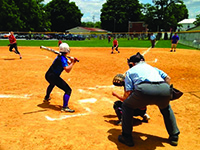
To Play A Summer of Softball

By Victoria Kidd


Some teenagers pass their summertime afternoons and weekends lounging about every open chair and bench at the mall. Others congregate in the basement of a particular friend’s house to log vast amounts of time on Xbox and PlayStation game consoles. It may seem that youth could very well be wasted on the young, as picture-perfect days are, arguably, squandered without any perceivable gain. Opposing that tired axiom about youth are the young athletes who spend their summers as members of travel fastpitch softball teams.

Fastpitch softball is widely considered the most competitive form of softball—a game that is similar to, but not the same as, baseball. For many years, it was even an Olympic event. The rules of the game vary slightly from baseball, but with pitching speeds reaching up to 60 or 80 miles per hour, it is equally as intense for many players, spectators, and coaches.

Coaches, in particular, have a unique perspective into the intensity of the game, as they are centrally involved in training players season after season. Team manager and coach, Chuck Siburt, of Inwood, W.Va., manages the Eastern Panhandle Scorchers, a nonprofit area travel team.

The team’s name is new, but the coach has been involved with its previous incarnations for six years, with different players coming and going. This year’s team includes players from Virginia and West Virginia representing Clarke, Warren, and Frederick counties in Virginia, as well as West Virginia’s Eastern Panhandle. Thirteen girls in total have come together and committed to a summer of playing softball, a sport that Siburt believes is equally as compelling as baseball, its more popular “big brother.”

“I feel that softball is much more intense, and even harder, than baseball,” he says. “A softball is definitely harder to hit than a baseball. A batter for baseball is 60 feet, 6 inches from the pitcher. In softball, the batter is 43 feet from the pitcher, and by the time the pitcher strides out and releases the ball, the batter is about 40 feet away.” This difference may seem unimportant until you factor in reaction time. With less distance between batter and pitcher, the batter has less time to evaluate the pitch, make adjustments in stance, swing, and (hopefully) connect with ball.

The thrilling and intense nature of softball play is even more complex for travel teams because the commitment to “travel ball” (as it is sometimes called) requires a player to give up almost every weekend of their summer for in-season play, while also pledging additional off-season Sunday afternoons from the middle of November to the middle of March to practice. The Scorchers compete in nearly 50 games during the tournament season, with three to four games played each Saturday and one to two played each Sunday. “We play more games in a single day than most high school teams play in a week,” Siburt observes.

The potential payoff for that commitment is great. The college softball season overlaps the high school season, creating a challenge for college coaches, according to Siburt. College coaches who are scouting for players to join their teams often frequent travel tournaments where they can watch many players from around the area at once.

He explains, “The travel team experience is becoming a must-have in order to compete at the college level—especially for those hoping to obtain an athletic scholarship.” Essentially, when it comes to competing for the few softball scholarships that exist, travel ball has made high school game play a less desirable means for college coaches to find talent, and the presence of college scouts makes travel ball more competitive.

That level of pressure, coupled with the required commitment of time, may seem daunting, but the coach’s players will tell you that they cannot imagine their summers without travel ball. “Fastpitch softball runs in my blood,” says Robin Blowers of Winchester. Blowers, a rising sophomore at John Handley High School, has three years of softball behind her, but this is her first year playing for a travel team.

In addition to loving the “thrill of running bases, or the excitement of waiting for the pitch,” Blowers believes participation teaches valuable life lessons. She says, “I think that being involved in any sports team helps you learn how to deal with problems that come up within a group. It helps you to understand the value of working together and of cooperation . . . it helps you learn how to encourage others and pick them up when needed.” The belief that participation in travel team play provides valuable experience beyond the athletic variety is not exclusive to Blowers.

“The whole team is pretty much like family,” says team member Katherine “Kat” Ramey of Winchester. Ramey, a recent graduate of John Handley High School, has played softball for 10 years, but has been a member of a travel team for the past three years. She asserts that travel ball has complemented her education with lessons in teamwork and leadership. “I’ve been able to learn how to cooperate with others, and I’ve been able to learn how to adjust for people’s personalities and how others react to situations.”

Morgan Mills of Jefferson County, West Virginia, agrees. “Travel ball is a lot more competitive than school ball, but you get a chance to get really close to your team members.” Mills, a rising senior at Washington High School in Charles Town, has played travel ball for three years. She agrees that participation teaches leadership and cooperation, but she perceives there to be another benefit to travel team involvement.

“A lot of girls my age are staying out late and getting into trouble, but I have to get up early to be ready to go to our games,” she explains. The temptation and pressure to make bad choices tapers when one has committed the summer to team play. “The game has kept me focused. It’s taught me that if you love something, you have to make good decisions and you have to make sacrifices . . . it has been good for me.”

These life lessons, according to Coach Siburt, are an integral part of the program’s philosophy. “The Eastern Panhandle Scorchers was developed for athletes to engage in quality, competitive experiences,” he says. “A competitive athletic experience can produce a good work ethic, enhance social development, and contribute to mental and physical health, while teaching the value of personal responsibility, self-discipline, self-motivation, and teamwork.”

While these leadership experiences are undeniably priceless, they do not come without costs. Tournament fees can range between $490 and $1,400 for a single weekend of play. Players are charged $400 a season to play, but that fee barely covers uniforms, batting helmets, and other expenses. Fundraising efforts, including the solicitation of team sponsorships and outright tax-deductible donations, are essential to the team’s success.

Siburt says, “We have a very young team with three rising seniors this year. We would love to give them the opportunity to play in a college showcase tournament . . . but these are the most expensive tournaments.” The community’s financial support provides the team members with a chance to be noticed by college scouts that attend college showcases, so the team is always fundraising just to gain the opportunity to play.

But the work is worth it, according to Clarke County resident and Scorchers player Destiny Pierce. She has been involved with travel ball for three years, but playing softball for seven years. Her lengthy involvement with softball provides her with a unique perspective and adequate experience from which to describe a travel team player’s life.

“To me, softball is both a team sport and an individual sport,” she says. “I have to work on my own and practice to better myself and to be a better player, but I also have to work within the team. It’s hard work, but it’s also a valuable life experience and learning experience. It’s helped me grow a lot.”

The life of a travel team player is hectic, but youth is fleeting, and these players are steadfast in their belief that every early morning, grueling bus trip, sweat-filled afternoon, and exhausting practice is worth it. To follow the team’s play or to find out how you can help them compete in more tournaments, visit www.facebook.com/EPScorchers18u, or better yet, take a weekend to attend a travel tournament to see firsthand what these young athletes can do with a summer of softball.

The Unflappable Blacksnake

By Doug Pifer


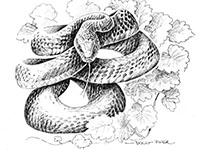
My wife called from the yard, “Come see the big beautiful blacksnake.”

She wouldn’t call me down just to see a snake unless there was something unusual, so I came and met a brief standoff scene. In the yard our two setters stood intently on point on either side of my wife on one side of the fence, and our donkey stood on the other. In the midst of us all, cornered against the fence, was a blacksnake.

If ever a legless creature could stand, this magnificent snake stood, coiled in a defensive spiral. Facing off two bird dogs, two humans and a donkey, any of which could have killed it, the reptile seemed alert but calm. Only its fork-tipped tongue moved, in and out of the closed mouth, even when one of the dogs would warily approach and then retreat.

I snapped a few pictures on my phone and we quickly moved the dogs away so they wouldn’t harass the snake. The snake slowly uncoiled and glided through the grass toward the wooded fence line.

Drama is routine for a predatory animal like a blacksnake. I’ve heard the commotion a tree-climbing snake causes among the resident birds. I’ve watched a barrage of parent birds attack a snake with its jaws clamped around a nestling. One morning a series of loud shrieks led me to a blacksnake holding a baby rabbit in its coils, just as our cat and a wild red fox, coming from different directions, arrived on the scene. And when they aren’t hunting, snakes are continually heckled and mobbed.

In all of these instances, the snakes seem to maintain a zen-like composure while being attacked. Perhaps their reptilian brain instinctively delays a response, or maybe they’ve learned to accept persecution as part of life. A snake’s first reaction upon being seen seems to be to remain motionless. This helps it blend into its surroundings and disappear. Unfortunately, this pause has resulted in too many blacksnakes being killed by humans.

When I was growing up, I seemed to be surrounded by people who, through superstition, fear, or ignorance, killed every snake they met. As I’ve grown older, I’m heartened to encounter more people who respect snakes as useful predators or as fellow creatures who prefer to retreat from humans and bite only in self-defense when surprised or cornered.

Snakes face more dangers now than ever before. Species once common in city backyards are now hard to find, as vacant lots are developed or transformed into buildings or parking lots. Snakes’ nesting and hibernating places are being destroyed by industrial and residential development. Our ever-increasing free roaming dogs and cats kill and eat snakes. Modern farming methods increase the chances of snakes being destroyed by harvesting and mowing equipment. And those that survive all this face a daily threat from getting run down on a highway.

Stop and look when you encounter a snake. Show some respect and let it pass. It may be the last one you’ll ever see. 

Southern Discomfort: A Local Species Faces Global Challenges

By Amy Mathews Amos

“It’s a rattlesnakey kind of day,” says Tom Akre as he guides his pickup truck along a dusty gravel road in George Washington National Forest near the Virginia–West Virginia border. That’s not a good thing. It’s late May—quite late for nesting wood turtles. They usually start nesting by the middle of the month. But the cold and snow of multiple polar vortexes delayed spring this year. So far, none of the 55 female turtles in Tom’s study area has dug a hole and deposited her clutch of eggs.

On this day, the weather is finally glorious—sunny, low humidity with temperatures in the low 70s. Good for rattlesnakes and people, but not for turtles. Too much sun, and they overheat. Too dry, and they desiccate. At this point in the year most females are heavy with eggs. But unless the conditions are just right they’ll stay put, hiding under leaves in forest glades or retreating to the cool streams.

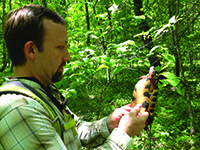
Tom is a wildlife ecologist at the Smithsonian Conservation Biology Institute in Front Royal, Va., who has agreed to let me shadow him for a day in the field. He’s an easy-going guy with cheerful blue eyes and a ready smile under his light brown beard, and he guides his six field assistants—all young interns and graduate students—with a friendly firmness that keeps them on track. But his research subjects are finicky.

We spent the morning searching for turtles along the Forest Service road, the hillsides rising up from it, and the creeks flowing beside it. Tom and his crew have placed radio transmitters on many of the females to track them as they migrate from the streams where they hibernate to the spots they ultimately choose to lay their eggs. Their radio transmitters can send signals up to a mile away, but those signals often bounce off the walls of the steep hillsides. Today, the clicks on the radio receiver have lured us repeatedly up steep slopes only to send us bushwacking back down again when the signal shifts to the valley below. So far, we’ve found four turtles. Some by following those confusing radio signals until they finally zero in on a female. Others—such as the big guy nicknamed “Ultra-male”—by simply searching the ground around moist seeps where turtles feed. Despite the bright orange coloring on their legs and necks, wood turtles are surprisingly hard to spot.

But it’s now mid-afternoon, and we haven’t seen any nesting females. And although I’ve been relishing the sunny weather as I traipse through the forest with Tom and his crew, everyone else has been hoping for rain. Just the right amount of rain at the right temperature should break the nesting bottleneck, prompting a slew of ready females to move out of the seeps where they feed and onto the sandy banks where they nest. The right amount of rain will moisten the soil making it easy to dig. The right temperature will keep the cold-blooded turtles active. We need, literally, the perfect storm.

Southern Limits

Eastern West Virginia and Rockingham and Augusta counties in Virginia mark the southern extent of the wood turtle’s range. In a world that’s growing warmer, that’s bad news if you’re a turtle. A recent study in the scientific journal PLoS One found that many North American turtles are at risk from climate change. Evidence from past ice ages suggest that the rate of change today is too fast for turtles to shift their geographic ranges and find new suitable habitat. Wood turtles live throughout the northeastern United States from Maine to Virginia, but they’re at risk everywhere. Their far-ranging and finicky habits—searching for just the right locations to hibernate, feed and nest—make them vulnerable to development throughout the region. And their pretty orange legs and neck make them attractive as pets. Poachers illegally catch wood turtles and sell them to collectors for hundreds of dollars each. In fact, when I first arrived at the forest that morning, Tom made me promise not to reveal the study site’s location. “The last thing we want to do is tell dealers where they can find turtles,” he said.

The International Union for the Conservation of Nature, which monitors the status of wildlife globally, considers wood turtles endangered. The states of Virginia and West Virginia both have officially listed wood turtles as a species of greatest conservation concern. And biologists from state wildlife agencies, universities and conservation groups throughout the Northeast are now coordinating their research efforts to keep wood turtles off the federal endangered species list. As part of that, Tom and his crew are trying to understand why wood turtles choose some locations over others, and whether those choices are actually good in a world that is vastly different from the one in which they evolved.

Eons ago, wood turtles in the Shenandoah and Potomac valleys probably could have met all their needs within a pretty small area. They could nest each spring in the soft sandy banks that form along bends in the river and nearby tributaries. They could feed in the adjacent forest, which had just enough shade to prevent overheating and—thanks to occasional flooding that culled some of the trees—just enough sunlight for tasty plants to grow along the ground. Because their nests were so close to the water, their tiny offspring wouldn’t have far to go before reaching the relative safety of the stream. In winter, they could avoid the worst of the flooding by hibernating in smaller side streams, less likely to wash them away in severe storms. If some populations did get washed out, there were plenty of others elsewhere to recolonize the site the next year.

Today it’s different. Houses, farms, and roads hug rivers and creeks, not sandy beaches. The surrounding landscape isn’t a turtle-perfect blend of patchy forest, either. Instead, it’s suburban lawns, cow pastures, and farm fields. After spending the winter hibernating in a small stream, wood turtles head out each spring in search of food and nest sites, sometimes covering miles in their search when they don’t find the right conditions nearby. Graduate student Jeff Dragon spelled out the reality bluntly for me that morning. “If you apply that to Clarke County or even Fairfax where they used to live—you take a turtle from a creek and draw a line two miles around from the point where they’re nesting—you’ll see that they’re going to have to cross six roads. And then they have to come right back and cross those six roads again [on their return]. They might make it this year, they might make it next year, but they normally would live 60 or 70 years, and they only replace themselves a few times in that life span. So when a turtle like that gets hit, it’s going to cause extinction really fast.”

At the ripe old age of 27, Dragon feels like he’s already seen this happen in South Jersey where he grew up. He was a turtle fanatic as a kid, spending his summers catching box turtles and transplanting them around his neighborhood for fun. But at some point the turtles disappeared. He blamed the development boom of the 1990s and decided to study turtle conservation in college. He’s been tracking the survival rate of wood turtle hatchlings for his Master’s Degree at George Mason University and working closely with Akre to understand how turtle choices and human activities affect that survival.

Looking for Answers

Traffic is minimal in the National Forest where the team works, but the Forest Service’s gravel roads affect turtles in other ways. We’re in the mountains, and the small forest streams here generate few, if any, sandy banks. Instead, the most obvious open banks occur along the twisty dirt road. After tracking females in his 12 square-mile study area for years now, Akre has a good idea of which banks attract nesting wood turtles. “That’s Queen’s Bank,” he says as we bump along the road in the hot sunshine, so named for an assertive female nicknamed Queen who frequently nests there. But we see no sign of her. Presumably, she’s waiting for this afternoon’s predicted rain shower.

Tom points out other roadside banks where wood turtles often nest as well. But his research is revealing that, despite their superficial similarity to idyllic riverside beaches, these nest sites often don’t turn out well. For one thing, they’re not alongside the water. So once hatched, baby turtles no bigger than an Oreo cookie might have to travel overland hundreds of yards or more to get to the stream’s safety. Along the way, they’re an easy target for raccoons and other predators. But many nests don’t even last long enough for the hatchlings to attempt their maiden trek to the stream. Predators find the eggs and eat them before they hatch. Or the soil along the banks prevents adequate drainage, and the eggs get waterlogged. Akre wonders if these forest roads inadvertently create ecological traps, luring females with their open beach-like exposure, but poorly mimicking the conditions their offspring need to survive.

So he’s gathering data to find out. His research is funded by the Virginia Department of Game and Inland Fisheries with in-kind support from the U.S. Forest Service and the Smithsonian Conservation Biology Institute. Once focused almost exclusively on captive breeding of endangered, often foreign, wildlife as an arm of the National Zoo, the Institute has expanded its work in recent years to address wildlife conservation in Virginia as well. That includes working with private landowners through the Virginia Working Landscapes Program, and partnering with George Mason University to provide students with hands-on internships and graduate fellowships. That partnership has provided Akre with all six of his crew members here today.

Together, they’ll find about 40 wood turtle nests in this section of the forest. They’ll protect half the nests from predators and measure just about everything they can think of that might make these sites attractive to a nesting wood turtle or affect the survival of her offspring: The type of soil and its temperature over the summer, nearby vegetation, the direction and angle of the slope, and the distance of the nest from the closest water. When the eggs hatch in August, the team will attach mini transmitters to the hatchlings’ tiny shells, and track them for at least 80 days to see how they fare.

They’ll leave the remaining nests unprotected and set up cameras that automatically snap photos of any warm-blooded creature that moves nearby. Predation is high for turtles just about everywhere. But Akre cites scientific studies showing that predators are more successful when they hunt along straight lines—such as trails or dirt roads—than they are by simply searching around in the mosaic of natural landscape. Dragon goes even further. “They learn,” he told me that morning. “They know to run these roads during this time of year. They think ‘oh May and June, it’s time to get those eggs.’”

Here at the southern end of the wood turtle’s range, a warming climate could soon become another problem. Akre’s not yet sure why wood turtles don’t extend any farther south, but he thinks it might be related to high summer temperatures drying out nests. Those temperatures are expected to get even higher in coming decades. At a recent conference on climate change in West Virginia, state climatologist Kevin Law predicted that the number of days exceeding 95 degrees in a typical year could increase from 0 to 10 days now, to 5 to 30 days by mid-century. He also expects extreme rainfall events to increase. Today, about 7 to 11 days experience more than an inch of rain each year. In 50 years, that could be 8 to 12 days. Flooding from extreme weather can wash away turtles and wipe out nests: Just two weeks previously, flooding from a heavy mid-May rainstorm killed one of the team’s turtles.

Rainy Release

The team has split up this afternoon—I’ve joined Akre and his project manager Ellery Ruthie, while Dragon led two interns in another section of the forest. It’s now time to check in and compare notes. Akre slides the pickup in front of a compact car with New Jersey plates parked alongside the road and we find Dragon’s group in the nearby forest. They tell us they’ve found several turtles in the area, but none nesting. Above us, the sky starts to darken and thunder rumbles in the distance. But the crew is too jaded to pin much hope on it. The turtles should have been nesting for days now; the crew scrambling to keep up. Every day they’ve expected this to be the day, only to be disappointed. Suddenly the clouds let loose and large cool drops splatter on all of us. We’re quickly getting drenched and rush back to the cars for rain gear and temporary cover.

No one expects the turtles to respond immediately—it could take a half hour or more for the rainfall to actually loosen up the dry soil. Tom drives down the road on the lookout anyway. He doesn’t get very far: There in the middle of the road, mere minutes after the cloudburst, is the turtle known simply as number 403 heading steadily towards the sandy bank on the other side.

We spot three more nesting females that afternoon, all of them in the exposed banks sloping uphill along the Forest Service road, plus one more in the forest still waiting for just the right time. Number 403 isn’t quite ready to dig, and Ellery places a radio transmitter on her so the team can track her in coming days. Number 705 is testing out the soil when we spot her, trying to determine if she found a good spot. Number 708, nicknamed Cracky for the obvious crack on her shell, is digging her nest. And number 96 is finishing up, packing in the dirt to protect her just-laid clutch.

I decide to pack it in myself. It’s six o’clock  in the evening and I’m wet and chilled from wading through creeks, hiking through seeps, and searching for turtles in the rain. Now that the action has started, the crew has a long night ahead of it. I flick yet another tick off my arm and head out, hoping that the site is secure, the turtles choose wisely, and the weather—now and in the future—cooperates.


Amy Mathews Amos has worked at the interface of environmental science and public policy for 25 years as an analyst, advocate, consultant and now writer. Her writing has appeared in The Washington Post, Pacific Standard, Earth Touch News Network and elsewhere. She serves on the boards of the American Conservation Film Festival and Marine Conservation Institute, and blogs for The Downstream Project at thedownstreamproject.org. Follow her on Twitter
@AmyMatAm.

What is your most treasured material possession and why?

Interviews and photos by Jennifer Lee


“The door to my garage. My husband Jay designed the glass panel that’s in it, and it’s why I married him! It was on his front door when I met him.” —Peggy Duvall, 56, White Post


“My down sleeping bag that I got for Christmas when I was 17. I walked into the orchard late that night and slept in that bag. Almost 40 years later, and I still carry it with me and use it when I need to!”  —Glassell Smalley, 56, Berryville


“All of them! As a hoarder in training, how could I choose?” —Hilary Dunn, 22, Berryville


“The snake bracelet from the Holy Land that my stepdad’s mother gave me. It wraps around my arm and has little red eyes and is about 70 years old. It was one of her favorite things that she bought for herself and she gave it to me. Unfortunately, I don’t wear it. It sits in a box because I’m afraid it will break.” —Jordan deButts, 28, of Boyce and New York City


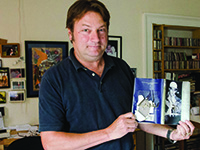
“My copy of Fear and Loathing in Las Vegas, by Dr. Hunter S. Thompson, that he personally shot with his pistol and signed to me. I received it as a gift from a dear friend who got to interview him for the Atlantic Monthly online magazine.” —Allen Kitselman, 54, Berryville


“My violin. I got it when I was 16, when I was finally big enough to hold a full-size violin, and I’ve been playing it for 31 years. I played it at Carnegie Hall when I was 16, and now I play it with The Bitter Liberals band.” —Gary McGraw, 47, Berryville